Architecture
The native implementation separates storage, sampler semantics, and host integration.
Desktop Workspace Modules
Axkdeck separates the shared workspace shell from backend orchestration and
device presentation. src/App.svelte selects a bundled backend application from
features/backends/registry.ts; the existing axklib transport, A-series catalog,
audition, editing and dialog workflows live behind features/backends/axklib/.
An alternative backend application does not implement ImageTransport or use
A-series object types merely to enter the shell.
WorkspacePresentation supplies navigation, central content, optional lower
tools and an optional inspector. It can also supply object tabs, selection
actions and playback controls. All pane geometry, visibility toggles, interface
scaling and the Device/Files switch belong to WorkspaceShell. The common image
action area is supplied separately from presentation-specific navigation. The
axklib backend supplies the current A-series Device presentation; adding another
device presentation must not introduce device switches into the shared shell.
Object editing is organized independently of backend selection. Shared draft,
history, save/recovery and exit-confirmation behavior lives in
features/object-editor/; device/object pages and parameter semantics live in
features/devices/a-series/sample/. The editor registry selects the explicit
server-provided a-series/sample profile. It does not infer a device from a
filename or add device-specific branches to Files mode. Future device profiles
provide their own field definitions, validation, write mapping and audition.
Drafts are keyed by session and object identity. A revision change revalidates the original payload digest and placement before a draft can save; a changed payload remains a conflict until explicitly discarded. Saving sends only changed parameters with revision and payload preconditions, through the existing atomic mutation job. Playback-window and loop changes share that transaction. Browsing another Sample, volume or mode does not write or discard drafts. Source object bytes are read on demand for the bounded editor snapshot rather than retained in every catalog entry. Desktop window-close and application-quit guards cover both dirty drafts and unresolved writes.
The Sample editor keeps main tabs beside identity and Save actions, with one active subpage and a persistent draft-audition strip. Waveform boundaries are presented as start/end positions and mapped to the native start/length contract; numeric entry and drag gestures share the same validation and undo history. Level and filter scaling use native MIDI-note coordinates, with a keyboard and precise breakpoint controls. Common numeric and choice controls live in the object-editor layer, while parameter groupings remain device-specific. Shared spacing tokens keep panel padding, section gaps and table cells compact without shrinking text or input targets. Form-only pages use left-aligned, bounded columns; intermediate widths keep Output routing below Mix. Pitch has only Tuning and Sample portamento. Entirely unavailable groups use compact columns instead of reserving slider-width space. Missing columns wrap rather than stretch apart. The identity header reserves dirty-marker space so tabs do not move on edit. Collection identities also reserve a compact dirty-marker slot; unsaved edits cannot change name/metadata height, stereo-indicator placement or name truncation.
Graphical pages share a resizable graph/controls layout, plot frame, keyboard axis and compact parameter groups. Wide panes start with equal-width columns; below 900 CSS pixels the graph stays above switchable control groups. Controls scroll independently, and layout choices do not dirty the object. The shell accepts a preferred lower-pane height from its presentation; Sample editing requests 360 CSS pixels or one third of the workspace, subject to available height and manual resizing. Waveform editing remains full-width. Workspace and graph splitters use one shared component with a single line inside an eight-pixel pointer target, keyboard resizing and a reset action.
Responsive editor thresholds use shared ResizeObserver measurements of layout
width, not zoomed bounding rectangles or CSS container queries. This keeps
stacked control-group navigation aligned with layout under native WebKitGTK
page zoom. Choice controls use measured label widths before showing segments;
otherwise they use a bounded menu. The audition strip reserves stable button
and status geometry across playback transitions.
Sample Info keeps source duration alongside sample-rate metadata, rather than
in a separate footer. It describes the underlying source, not the trimmed or looped range.
Loop mode belongs to Waveform after Loop end, never to the audition strip.
Sample Info separates saved Loop Tempo and Wave Start Velocity Sensitivity from
local Display & audition preferences and Tools. End Type selects absolute Address
or Length/Time/Beat relative to each corresponding start; it does not rewrite
addresses or System settings. Local preferences are shared within an image session
and survive Sample switches. Calculate uses four beats and octave normalization
by default, with explicit beat-count and normalization controls.
MIDI Set owns Pitch bend and Velocity Low Limit/Offset. Mix & Key owns Poly/Mono
and Velocity sensitivity. Expansion & Velocity precedes Level scaling.
Editor popups observe their rendered size and keep the edge nearest the field
anchored as filtering changes the list height. Opening direction stays fixed until
dismissal; content scrolls within the available space on that side.
Envelope stage models and parameter bindings belong to the device adapter. Amplitude, filter and pitch share a full-width stage presentation while retaining their distinct level ranges, editable endpoints and Hold behavior. Envelope spacing responds to native rates; horizontal handles edit rates and vertical handles edit levels in one undoable gesture. Release is edited at its endpoint, not an artificial midpoint on the slope. The Amplitude release endpoint stays at zero; Filter/Pitch endpoints edit both release rate and level. Spacing is relative, without calibrated transition times. Maximum-rate transitions do not receive a visible minimum-width ramp; AEG release 127 is immediate as documented by Yamaha. Offscreen handles are hidden inside the fixed viewport, with Fit/zoom restoring access. Rate dragging may extend beyond the viewport without expanding its drawing surface or changing the bounded level domain. LFO plots show relative speed, delay and buildup, with independent pitch, amplitude and cutoff traces and an illustrative Sample & Hold pattern. Sample & Hold speed belongs to the Program. Delay shifts the clean oscillator trace; a separate guide shows relative buildup rather than distorting the first cycle. Analytical corners retain vertical discontinuities.
Graph titles, readouts and tools share one fixed-height row outside the curves. Shared drag handling freezes the coordinate frame and grab offset for a complete pointer gesture, coalesces movement per animation frame, and flushes the release position. Draft patches publish related values atomically. Canvas buffers and theme colors are refreshed on size or theme changes, not on every parameter edit. Envelope viewports persist per draft and envelope page until explicit zoom or Fit to width; editing, releasing a handle and undo do not auto-fit.
Filter and Sample EQ have separate graphical subpages. Generic plotting and handle components accept neutral traces and coordinates; A-series adapters own the parameter bindings and response models. Filter curves are schematic and use native cutoff/Q values, not calibrated frequency units. The EQ response uses the pre-quantization parameter response for its solid editing curve. An optional dashed overlay shows stored Q13 coefficients until an EQ parameter changes, then regenerated draft Q13 coefficients. Low-frequency coefficient rounding can substantially displace the plotted peak, so it is not used to position the editing curve. Neither curve is a measured hardware response. The native writer's coefficient equations and maintained reference vectors are unchanged. These plots do not extend audio preview into EQ, filter, envelope or LFO synthesis. A transient vertical gain handle follows the filter trace on hover and remains keyboard reachable. Its coordinate domain is frozen during a drag; it changes only gain, with Shift for finer movement and one undo step. Shared handle help appears on hover or focus and names the gestures actually supported by that point. EQ uses one frequency/gain handle. Wheel or Alt-drag edits Peak/Dip width; normal wheel and Alt+Arrow steps are 0.5, or 0.1 with Shift. Alt-drag uses twice the original width sensitivity; Shift-drag reduces pointer sensitivity fourfold. Frequency snapping has hysteresis around native discrete boundaries, and each drag or wheel burst is one undo step. Shelves retain fixed width. These interaction changes do not alter coefficient math.
Velocity range uses a compact vertical soft-to-hard MIDI velocity band beside
paired numeric boundaries and crossfade controls. It is not a keyboard range
or a calibrated loudness meter. MIDI/CTRL choices use shared searchable,
keyboard-accessible popups. Clearing a search preserves the assigned parameter;
only choosing an option changes the draft. Popup placement, dismissal, numeric
suffix alignment and slider focus treatment are shared across editor controls.
The Control subpage presents all six assignments as numbered rows with
Controller, Function, Type and Range columns, retaining distinct accessible
field names. Unsupported values retain their raw value and format warning;
explicit supported replacements can repair them. Absent fields display
Unavailable with a format-specific reason. Storage identity (188/224 bytes) is
independent of parameter assessment and of A5000-only output requirements.
Generation-aware rules own the native/later field locations and domains used by
decoding, validation, capability serialization and conversion inspection.
Ordinary Save retains the stored format. A clean-draft conversion dialog previews
the separate convert_sbnk_format transaction and blocks all known losses.
Conversion reuses the editor's write-completion/recovery state machine, retaining
selection, document, navigation and view preferences. The original payload hash
guards every write. Capability reasons and inactive-mode help are available on
field-label hover and keyboard focus. True stereo pairs permit scalar expansion
edits without changing topology; retained expanded/duplicate-source pairs remain
restricted and explain why.
Program storage metadata and conversion are independent of Sample parameter profiles. The library owns the generation-specific raw-byte conversion plan; the application exposes a discriminated Program capability while keeping its parameter editor null. The frontend shares the conversion dialog and guarded write/recovery lifecycle, selecting Programs by numeric slot and payload digest. Conversion changes one PROG only, not dependencies or SYSTEM2 Multi assignments.
Position units, zoom, snapping, monitor lead-in, beat-count selection, preview note and audition volume are local view settings. Only an explicit tempo calculation or parameter edit changes the draft. Source-rate PCM is loaded on demand for zoom, zero-cross snapping and audition, with a 128 MiB working limit and temporary-resource cleanup. Changing editor identity or its source snapshot releases cached PCM and stops its preview. Loop Remix, destructive PCM operations and complete synthesis preview remain outside the implemented editor.
The reusable Files components depend only on FilesystemAccess and neutral
entry/page contracts in lib/filesystem.ts. A backend adapter translates its
wire representation into that contract. It provides stored entry identities,
parents, roots, names, sizes, paging and full-root search; it does not project
sampler relationships into synthetic directories. The sidebar selects roots or
partitions, while the central tree owns directory expansion. Unknown files stay
visible without a device interpretation. Files supports browsing, inspection,
directory creation and confirmed file/recursive directory deletion on writable
SFS roots. Raw file/directory exports are also available for readable roots,
including read-only images. Import review and FAT mutation controls use the
same per-root capability and transaction contracts.
Files selection is scoped to the active root and rendered entries. Modifier clicks and keyboard ranges support batch deletion; context menus retain an existing selection. Focus-only navigation does not alter the batch. Changed searches clear selection, and collapsing a directory replaces selected hidden descendants with their visible parent. Refresh restores surviving unique paths, not reused entry IDs. Deletion review includes the complete selection; execution removes redundant descendant targets and submits one atomic job.
Creation and import destinations use actual selection, not the retained
keyboard cursor: a selected directory, a selected file's parent, or the active
root after deselection. Background clicks clear selection without discarding
expansion or scroll. Dialogs capture their destination before editing starts.
Both cross-mode inspector actions use the fixed InspectorModeFooter, labeled
To Files and To Device, outside the scrolling properties.
The axklib-specific AxklibFilesView supplies a SU700 floppy import adapter.
Generic Files components only know its command and drop-interception interface.
The backend advertises supportedImports: ["SU700_FLOPPY"] for writable SFS
roots containing a recognized SU700 volume. Empty or unrecognized roots do not
advertise this operation. Other backends can supply their own import adapters.
SU700 import accepts one complete, flat FAT12 image and creates a new named
volume with SONGCONT.DAT, SUSQ songs and SUSP samples. Stored eight-byte
basenames, including internal padding before the extension, and all payload
bytes are preserved. Extra files are included by default and can be deselected.
The shared destination chooser is new-volume-only; merge, overwrite, disk-set
reconstruction and SU700 object editing are not supported. Inspection validates
control references, complete payload boundaries, names and destination capacity.
Execution rechecks source identity and image revision, then uses one atomic
Files transaction with rollback. This is host-validated import support, not a
claim of hardware playback validation.
The separate FilesystemMutationDriver binds execution, observation,
cancellation and image refresh. The axklib adapter uses the shared job controller
and invalidates audition before mutation. Review captures the session, entry
identities and revision. A committed write followed by failed refresh can only
retry refresh; interrupted job observation checks the same job rather than
resubmitting its edits. Per-root capabilities disable unsupported controls.
FilesystemExportActions supplies the session-bound export job driver and host
destination adapter. Partition menus and the Files toolbar share one review
workflow with a frozen selection/revision, exact output paths and omission
notices. Managed-local batches use one native folder picker; remote sessions
use the existing destination chooser. The selected route survives failures.
Uncertain execution checks the existing job rather than resubmitting. Failed
local download publication retains its archive for an explicit destination
retry; successful publication or closing the review releases that archive.
Export does not mutate the image, refresh selection or repair object links.
Device and Files are independent capabilities. Recognized A-series objects enable Device; empty SFS images also allow A-series authoring. Files-only images open in Files with Device unavailable. Archives and standalone object sources can have Device without a filesystem view. No Akai or E-mu backend is bundled.
The Files controller retains per-root selection, expansion, search and scroll state while switching modes. Revision changes discard cached entries and revalidate the active root's identities. Cross-view navigation requires a unique physical entry/object mapping, opens ancestors, loads the required pages and reveals the row once. It never guesses by display name. Split floppy sets retain their separate physical roots without claiming an ambiguous combined-object mapping. Loading and revision failures remain visible instead of falling back to a projected object tree.
Public Documentation Boundary
Public documentation describes supported contracts, limits, validation rules, and concise hardware compatibility status. Small retained test fixtures may document their identity, hash, topology, and active test purpose. Runtime diagnostics describe the input contract and corrective action.
Format pages specify stored bytes, encoding, relationships and modification constraints independently of a particular decoder. Unspecified meanings and preservation requirements remain explicit. API symbols, report field names, application workflows and generated-output conventions have separate contract pages. Only installed SDK interfaces are presented as public C++ APIs.
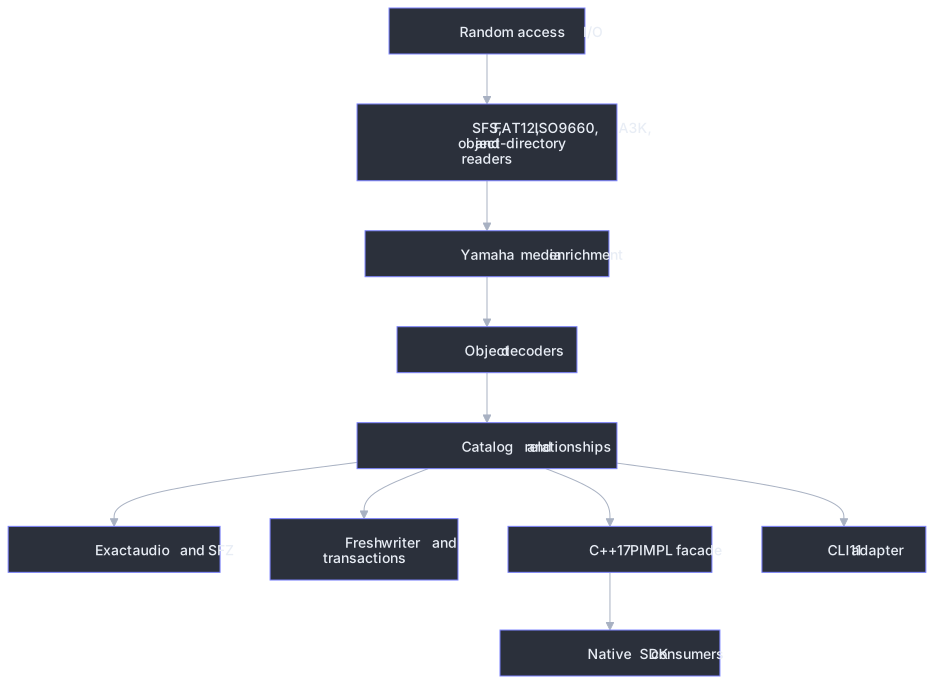
The private C++23 engine owns format behavior and typed errors. The shared SDK facade owns PIMPL sessions, results, pagination, cancellation, and progress. The CLI adapter owns argument parsing, exit codes, output layout, and report serialization. The CLI links the private engine statically; SDK consumers load the shared library.
The CLI follows a one-way dependency path:
platform entry -> CLI11 registration -> typed request -> command family -> axklib service
The source modules reflect that boundary:
apps/cli/main.cppandapps/cli/command_line.*convert platform arguments to checked UTF-8 and contain process-level failures.apps/cli/app.*registers the root command and dispatches typed requests.apps/cli/commands/owns independent analysis, extraction, report, package, and writer/transaction command families.apps/cli/schema/owns versioned machine-output data structures and their private JSON serialization.apps/application/src/content_id.*owns pooled-export identifiers and collision handling as an application-private extraction helper.
Command modules orchestrate public library services; they do not contain disk layout, object decoding, allocation, or audio-conversion rules. Core targets do not include CLI11 or CLI headers.
The media source modules preserve a separate responsibility boundary:
media_fat12.cppowns shared FAT directory and file reads;media_ex5.cppsupplies the separate read-only EX5 disk geometry and content projection.media_iso9660.cppowns the supported primary ISO9660 container profile.media_a3k_archive.cppowns the bounded read-only A3K archive profile.media_build.cppinventories metadata before loading a selected dependency closure, enforces public aggregate build limits, and validates written payloads through bounded range readers.media_write_fat12.cppadapts pinned FatFs to an in-memory 1.44 MB image.media_write_iso9660.cppowns the deterministic narrow ISO9660 layout writer and writes projected sectors directly to the reserved temporary file without retaining a second output-sized image buffer.media_yamaha.cppowns Yamaha object recognition, CD menu labels, catalog placement, flat AXK object directories, and structured paths.media.cppowns common media dispatch andMediaContainerorchestration.
These remain source modules in one core target. They are not separately linked SDK components.
Fresh-image and alteration operations use manifests and plans. Applying a plan writes a temporary destination, validates the result, and then completes the replacement. The output path must differ from the source image. Existing source images therefore remain unchanged.
The private write/package implementation is split by invariant ownership:
alteration_manifest_json.cppowns canonical JSON serialization and typed parsing, whilealteration_manifest.cppvalidates a complete typed transaction before any image I/O.alteration.cppowns stateful planning and mutation.object_write_codec.cppandsfs_write_codec.cppown bounded object-payload and directory-index encoding.writer_image.cppowns HDS geometry, allocation, and publication.package_manifest.cppowns canonical package JSON serialization and relocation bindings.package_import_plan.cppowns immutable import-plan identity and verification; media-specific capacity planning remains inpackage_import.cpp.
These are private source boundaries, not installed APIs. Binary fields are encoded through checked writers, and callers propagate an error instead of indexing past a malformed or incorrectly sized buffer.